Chicago
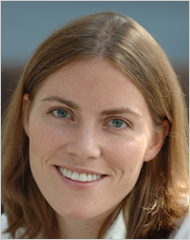
Emily Oster did AIDS research
The Economists and Their Research
- Oster on AIDS
- Fryer on Racial Inequality
- Finkelstein on Medicare
- DellaVigna and Malmendier on Health Clubs
- Olken on Corruption
- Gentzkow and Shapiro on Media Bias
- Gabaix on C.E.O. Pay
- Wolfers on Point Shaving
- Rothstein on Schools
- Chetty on Dividend Taxes (pdf)
- Karlan on Philanthropy (pdf)
Multimedia
On a summer day a few years ago, a recent college graduate named Emily Oster was talking to her boyfriend about the research that was, and wasn’t, being done on the spread of AIDS. She was an aspiring economist at the time, getting ready to go to graduate school, and she was struck by the fact that her field had little to say about why some countries had such high H.I.V. rates.
To most people, that may not sound like a question an economist needs to be asking. It’s more the domain of epidemiologists or public health workers, and they were already doing good work on it.
But economists have been acting a lot like intellectual imperialists in the last decade or so. They have been using their tools — mainly the analysis of enormous piles of data to tease out cause and effect — to examine everything from politics to French wine vintages.
As the daughter of two economists, Ms. Oster probably understood this better than most 22-year-olds. Her father, Ray Fair, invented a semi-famous economic formula that has an impressive track record of predicting presidential elections. Her mother, Sharon Oster, studies business strategy.
So during her time as a Ph.D. student at Harvard, the younger Ms. Oster took on AIDS in Africa. Her most provocative finding was that Africans didn’t really behave so differently from people in countries with much lower H.I.V. rates. They did not have many more sexual partners than Americans on average. And, like Americans, Africans had cut back on unsafe sex in response to AIDS — or at least relatively well-off, healthy Africans had.
Poorer Africans, who of course make up the continent’s overwhelming majority, had made fewer changes. They had less of an incentive to practice safe sex, Ms. Oster concluded, because many of them could not expect to reach old age, whether or not they contracted H.I.V. Any attack on AIDS should therefore include an attack on poverty.
“This is not the kind of thing epidemiologists would do. It’s not the way they would have framed it,” Ms. Oster, now 26, said. “It’s an idea only an economist would love.”
Whatever you think of her conclusions, there’s no denying that her subject is more interesting — and, yes, more important — than the esoteric fiscal and monetary models that once dominated economics. Ms. Oster is studying death, not taxes.
Last weekend, hundreds of economists gathered in Chicago for their annual conference, where they interviewed one another for job openings, presented new research papers and had the occasional glass of wine. This was my sixth such conference, and I have often been stunned by how much of the research here, like Ms. Oster’s work, would interest non-economists.
As “The Soulful Science,” a new book by Diane Coyle, puts it, there has been a “remarkable creative renaissance in how economics is addressing the most fundamental questions — and how it is starting to help solve problems.” The reams of data that computers can now crunch have ushered the field into a new golden age, Ms. Coyle writes, yet most of its accomplishments are not widely known.
So before this year’s conference, I did an informal poll of about 20 senior economists around the country and asked a single question: who are the young (untenured) economists doing work that is both highly respected among experts and relevant to the rest of us? Who, in other words, is the future of economics?
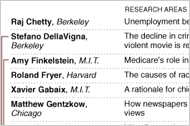
Thirteen names came up more than once, and I’m sure a scientific survey would have produced a longer list. As it is, though, the list is incredibly diverse. It includes Justin Wolfers, who once worked for an Australian bookie and is now an expert on online prediction markets , and Raj Chetty, who grew up in both India and Milwaukee and studies antipoverty policy.
Ms. Oster is on the list, and so is the boyfriend with whom she first discussed her AIDS ideas: Jesse Shapiro, now her husband. He has done innovative work on, among other things, the benefits of television for some toddlers. The two of them are the inaugural fellows at a University of Chicago research center run by Gary Becker (a Nobel laureate), Steven Levitt (co-author of “Freaknomoics”) and Kevin Murphy (winner of a MacArthur genius award).
In fact, the least diverse aspect of the list of 13 — the full roster appears above — may be the way that its members have chosen their mates. Six of them are married to another person in the group.
- 1
- 2