


 Science-Based Business Initiative Seminars
SEWP in cooperation with the SBBI at the Harvard Business School has been a regular part of a Fall and spring lecture series that meets at the Harvard Business School and other weeks at the Department of Economics, Harvard University.
[Full Seminar Schedule]
Upcoming Seminars:
Haris Tabakovic
(Harvard Business School
and The Brattle Group)
"From Revolving Doors to Regulatory Capture? Evidence from Patent Examiners"
(paper joint with Thomas Wollmann,
University of Chicago)
12-1:30
February 23, 2018
Baker 103, Bloomberg Center, HBS Campus
To RSVP or for questions on a seminar or to join the mailing list or arrange parking, please contact sbbi@hbs.edu
Past topics included:
AI and Jobs: The Role of Demand
Vehicle Electrification in China: Preferences, Policy, and Technology Trajectories
Digital Innovation in a Regulated Industry: Evidence from Software-Driven Medical Technology
Magenta Therapeutics - building a biotech in stem cell transplant medicine
Innovation in the Cell Phone Markets of US and China
Missing Women in Tech: The Labor Market for Highly Skilled Software Engineers
Robots and Drones at Work
Does Offshoring Manufacturing Harm Innovation in the Home Country? Evidence from Taiwan and China
The Role of Research Collaboration and Ownership Assignment as Determinants of Comparative Chinese Patent Quality
Innovation in the Cell Phone Markets of US and China
Rising Toward Half the Scientific Sky: China's expanding contribution to scientific publications
Technological Leadership (de) Concentration: Causes in ICTE
Biotech Venture: The State of the Ecosystem
Financing Novel Drugs
New insights into our genome that will
impact the biomedical enterprise
Research Funding and Regional Economies
Evaluating the Quality of Chinese Patents
The Mechanics of Endogenous Innovation and Growth: Evidence from Historical U.S. Patents
Happy Americans, Unhappy Japanese, and Chinese on the Move: How software engineers work and live in different countries
The Growing Importance of Social Skills in the Labor Market
The BioPharma Dilemma
Emerging Technologies and Regulatory Terrain: Reflections on the Decade of Nano
Connecting entrepreneurs in local ecosystem: From innovation to entrepreneurship theory
Gene Therapy The Bluebird Bio Way -- What's Bull*** Got to Do With It?
Governments as Partners: The Role of Collaboration in Cleantech Startup Innovation
Modelling Science, Technology, and Innovation: Key Challenges and Opportunities
Coordinated Expertise: How the Division of Knowledge Creates Co-Worker omplementarities
Bias Against Novelty in Science: A Cautionary Tale for Users of Bibliometric Indicators
The Ecosystem of Silicon Valley: Entrepreneurs, Venture Capital, and Accelerators"
Two Studies of Innovation in China
Killing the Golden Goose? The Decline of Science in Corporate R&D
The Mobiity of Elite Life Scientists: Professional and Personal Determinants
The Effects of Restrictions on Secondary Pharmaceutical Patents: Brazil and India in Comparative Perspective
Building a Biotech Company: Challenges and Lessons
How Do Patents Affect Follow-On Innovation? Evidence from the Human Genome
Effects of Attending Scientific Meetings on Research Outcomes
Financing and the Market for Ideas: Evidence from the Biopharma Industry
A Revealed Preference Analaysis of PhD Students' Choices Over Employment Outcomes
Subject Citation Networks and Science Policy
Repairing Broken Genes: Is Genome Editing Ready to Deliver Medicines?
The Importance of Corporate Venture Capital to Source Innovation in the Biotech Innovation Ecosystem
Science, Technology and Innovation in China
Identifying Career Pathways for PhDs in Science
Synthetic Biology for Real-World Applications
Collaboration, Stars, and the Changing rganization of Science: Evidence from Evolutionary Biology
The Effects of High-Skilled Immigration on Firms: Evidence from H-1B Visa Lotteries
The Experimental Revolution in Business
Cubist - Battling Superbugs:
The Intersection of Science and Policy
Endogenous Selection into Single and Coauthorships by Surname Initials in Economics and Management
The use and misuse of patent data:
Issues for corporate finance and beyond
Moving People with Ideas. Innovation, inter-regional mobility and firm heterogeneity
Pollution and Worker Productivity
Balancing strategy, market forces, employment needs and early stage drug development - Vapogenix
Using Bibliometric Data and Social Network Analysis to Model the Scientific Workforce
Evaluating Patent Licensing Agreements for Technology Diffusion at the U.S. National Labs
Agglomeration and Innovation
Where Do Firms Open R&D Labs in the U.S.?
House of Green Cards: Statistical or Preference-based Inequality in the Employment of Foreign Nationals
The Reverse Matthew Effect: Catastrophe and Consequence in Scientific Teams
Falling Behind? - Boom, Bust, and the Global Race for Scientific Talent
Are the 'Best and Brightest' Going into Finance? Career Choice and Skill Development of MIT Graduates
The Deteriorating Career Prospects of Scientists
Knowledge Spillovers from Clean and Dirty Technologies: A Patent Citation Analysis
Global Markets and Local Companies
Accelerating Innovation and Medical Product Development for Cancer, Diabetes and Infectious Diseases: Case Studies
Mobile Scientists, Networks and Performance
Trade Induced Technical Change? The Impact of Chinese Imports on Innovation, IT and Productivity
Why Do Women Scientists Get Less Cites?
Working with a non-profit disease organization to bring a new therapy to patients; the Vertex-Cystic Fibrosis Foundation collaboration
Prizes and Productivity: How Winning the Fields Medal Affects Scientific Output
Understanding Breakthrough Emergence through Missed Opportunities
Do Tax Credits Stimulate R&D Spending? The Effect of the R&D Tax Credit in its First Decade
Brain Drain: a Scale of Signaling Gaps? Lessons from US-Israel Case
Do Tax Credits Stimulate R&D Spending? The Effect of the R&D Tax Credit in its First Decade
Building Sustainable Companies in the Age of Capital Efficiency
From Lab Bench to Innovation: Critical Challenges to Nascent Academic Entrepreneurs
Effects of Changes in Federal Funding for Academic Life Sciences R&D: Crowding-In versus Crowding-Out in the
Post-Doubling Era
How a Non-Scientist Adds Value to Biopharmaceutical Research and Development
Experiences in the Emerging Profession of Technology-Based Entrepreneuring
Challenges Facing the 21st Century University: A View from the Office of Institutional Research
Globalization of Science and Engineering Research Within and Across Countries
Healthcare Venture Capital - from a practitioner's point of view
Analyzing Collaboration Using Harvard Catalyst Profiles
The Tragedy of the Risk-Perception Commons: Culture Conflict, Rationality Conflict, and Climate Change
Driving Innovation at the Intersection of Science and Application: The Power of Pasteur's Quadrant
Lobbying, Congressional Oversight and Agency Allocations in U.S. Science Policy: Evidence from Federal Funding for Rare Diseases
ComparativeEffectiveness Research and Health Expenditures in the Health Reform Era
Transforming Biogen Idec
Where Do Firms Patent? Measuring Intra-Firm Spillovers for R&D
Brave Blue World - new trends, emerging technologies and market opportunities
Designing Markets for Prediction
The Market for Patents: Themes Developed From the Files of One Million Recent Patent Applications
Commercializing Technology from University Research
Scale-Adjusted Indicators of Research Activity: The case of Scientific Collaboration
The Future of Engineering in the USA
Conference, November 17, 2008, held at Heldrich Center for Workforce Development, Rutgers University in cooperation with Labor & Worklife Program, Harvard Law School and SEWP -
[More information to come]
The Labor & Worklife Program at Harvard Law School
and the [National Bureau of Economic Research] (NBER)


The National Science Foundation awarded Jerry Marschke and Andrew Wang, both LWP Senior Research Associates, a three year grant to study the occupational trajectories and career earnings of STEM PhDs in the U.S.
[Go to Abstract]
Jian Wang, Reinhilde Veugelers, and Paula Stephan issued an NBER Working Paper in April 2016 on “Bias against Novelty in Science: A Cautionary Tale for Users of Bibliometric Indicators.” The paper suggests that papers with new ideas are high-risk, high-reward forms of research. In the short term, new ideas meet significant resistance from their “home” field or academic discipline. It can take a long time before new approaches gain traction, and thus there could be considerable risk, especially for younger scholars seeking to secure an academic career.
[Go to article]

In July 2016, Beryl Lieff Benderly featured this research in an overview for Science online called “How scientific culture discourages new ideas”
[Go to article]

By Richard B. Freeman
Amidst dire headlines and predictions that as many as half the jobs will be lost over the next two decades, economist Richard B. Freeman explores the rise of the robots and its implications for society. His article discusses robo-nomics and what can be done to respond to the challenges of advancing robotization.
By Beryl Lieff Benderly
December 10, 2015
EXCERPT:
“What is … striking is the low salaries,” writes scientific labor force expert Hal Salzman, of Rutgers University, New Brunswick, in New Jersey, in an email to Science Careers. The best-paid field is engineering, with an average income of just above $65,000, followed closely by math and computer science. Physics comes next, with an average income that just tops $50,000. Then come social sciences, “other science,” and chemistry, all in the high $40,000s. Biology trails distantly at $36,000. Graduates in education and health fields on average out-earn the biologists, and the arts and humanities scholars finish last.
 THE BOOMS & BUSTS OF SCIENCE FUNDING AND THE CASE FOR STABILIZATION
By Michael Teitelbaum, LWP Sr. Research Associate
September 2015
iBiology

16 J U LY 2015 | VOL 523| p. 371
Nature included suggestions from Michael Teitelbaum, author of Falling Behind?

by Yi Xue and Richard C. Larson
May 2015
"The last decade has seen considerable concern regarding a shortage of science, technology, engineering, and mathematics (STEM) workers to meet the demands of the labor market. At the same time, many experts have presented evidence of a STEM worker surplus. A comprehensive literature review, in conjunction with employment statistics, newspaper articles, and our own interviews with company recruiters, reveals a significant heterogeneity in the STEM labor market: the academic sector is generally oversupplied, while the government sector and private industry have shortages in specific areas. "
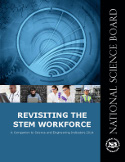
National Science Board report on the state of the scientific and engineering workforce:
Revisiting the STEM Workforce: A Companion to Science and Engineering Indicators 2014
February 4, 2015
The National Science Board (NSB, Board) examined recent STEM workforce studies and debates, consulted
numerous experts, and explored data in our 2014 Science and Engineering Indicators (Indicators) report to
develop insights that could facilitate more constructive discussions about the STEM workforce and inform
decision makers.
Three primary insights emerged:
I: The "STEM workforce" is extensive and critical to innovation and
competitiveness. It is also defined in various ways and is made up of
many sub-workforces.
II: STEM knowledge and skills enable multiple, dynamic pathways to STEM
and non-STEM occupations alike.
III: Assessing, enabling, and strengthening workforce pathways is
essential to the mutually reinforcing goals of individual and national
prosperity and competitiveness.
The Board received expertise and insights from LWP faculty co-chair Richard Freeman and LWP Senior Research Associate Michael Teitelbaum.

Is the United States falling behind in the global race for scientific and engineering talent? Are U.S.
employers facing shortages of the skilled workers that they need to compete in a globalized world?
Such claims from some employers and educators have been widely embraced by mainstream media
and political leaders, and have figured prominently in recent policy debates about education, federal
expenditures, tax policy, and immigration. Falling Behind? offers careful examinations of the existing
evidence and of its use by those involved in these debates.
[Go to Introduction to the book and preview of the chapters]
Featured in New York Review of Books, "The Frenzy About High-Tech Talent"
by Andrew Hacker, July 9, 2015 [Go to Review]
Discussed in Karin Klein's opinion piece in the Los Angeles Times, "The truth about the great American science shortfall,"
February 24, 2014
[Go to Article]

The beauty of science may be pure and eternal, but the practice of science costs money. And scientists, being human, respond to incentives and costs, in money and glory. Choosing a research topic, deciding what papers to write and where to publish them, sticking with a familiar area or going into something new—the payoff may be tenure or a job at a highly ranked university or a prestigious award or a bump in salary. The risk may be not getting any of that.
At a time when science is seen as an engine of economic growth, Paula Stephan brings a keen understanding of the ongoing cost-benefit calculations made by individuals and institutions as they compete for resources and reputation. She shows how universities offload risks by increasing the percentage of non-tenure-track faculty, requiring tenured faculty to pay salaries from outside grants, and staffing labs with foreign workers on temporary visas. With funding tight, investigators pursue safe projects rather than less fundable ones with uncertain but potentially path-breaking outcomes. Career prospects in science are increasingly dismal for the young because of ever-lengthening apprenticeships, scarcity of permanent academic positions, and the difficulty of getting funded.
Vivid, thorough, and bold, How Economics Shapes Science highlights the growing gap between the haves and have-nots—especially the vast imbalance between the biomedical sciences and physics/engineering—and offers a persuasive vision of a more productive, more creative research system that would lead and benefit the world.
Paula Stephan is Professor of Economics at Georgia State University and Research Associate at the National Bureau of Economic Research working on SEWP. She has served on the Board on Higher Education and Workforce at the NRC, the National Institute of General Medical Sciences Council, and the Social, Behavioral, and Economics Advisory Committee at the NSF.
Book Review from Kent Anderson and “The Scholarly Kitchen” blog:
[Go to Blog]
Interview with Kent Anderson at “The Scholarly Kitchen”: [Go to interview]
Paula Stephan named Science Careers Person of the Year, 2012
[Go to Article]
 |
The Harvard Medical School Catalyst is an over $200 million HMS and HMS affiliate project to improve clinical and translational research. From their website: the purpose of Catalyst is to develop "systematic way[s] for investigators from disparate disciplines and institutions to find each other and form teams, to gain open access to tools and technologies, and to obtain seed funding to embark upon new areas of investigation. This demands a systematic effort to remove the barriers and obstacles to cross-institutional collaboration. A catalyst lowers the barriers to reaction, and thus speeds a reaction that would normally have occurred at a much slower rate. Speeding the reduction of human illness is the only function of the Harvard Catalyst."
SEWP is working with the Lee Nadler, the Director of Catalyst and the PI on the founding NIH grants. He has two pilot projects. One combines an "open science" platform to develop new research strategies to combat disease with a novel team-building process to implement these strategies. The "open science" part will, hopefully, generate novel strategies that will be successful where previous strategies have failed because they arise from skill sets and perspectives that are traditionally not utilized. The team-building is novel because of incentives for collaboration across disciplines and institutions.
The second project addresses the waste due to duplication in medical science. This pilot catalogues and uploads into a virtual network information about research resources located within research laboratories in nine universities across the U.S. These resources include reagents, tissue samples, mice, lab equipment. The idea here is by making these resources that are available for swapping known, "eagle-i" (as it has been dubbed) will greatly reduce the cost of science, increase research productivity, and increase participation and diversity in science.
According to a report of May 2011 by The Information Technology & Innovation Foundation covering the years 2000-2008, the United States ended up “ranked 22nd out of 30 countries in government-funded university research and 21st in business-funded university research.” The researchers suggest that with the long-term decline of several centralized corporate R&D labs, it is crucial that university institutions pick up the slack for what they regard as lackluster R&D investment in the USA: [Read Article]
Nevertheless, a survey of the National Science Foundation indicates that during FY 2009 and FY2010, university R&D spending took a notably upward swing with the American Recovery and Reinvestment Act (ARRA). Published in March 2012, the NSF found in its Higher Education Research and Development (HERD) Survey that “When adjusted for inflation, higher education R&D rose by 6.0% in FY 2010”: [Read Article ]

With Washington facing Tea Party-inspired demands for government rollback and bipartisan calls for fiscal austerity, universities will find daunting challenges ahead in trying to build upon the ARRA surge in R&D spending. The U.S. continues to lead the world in absolute R&D spending, with $427.2 billion in gross expenditures on R&D (PPP adjusted) during 2011. Building upon a 22 percent annual rate of growth in R&D spending between 1996 and 2007, China came in second in 2011 at $174.9 billion, according to Battelle and R&D Magazine.

The economics blogger Mike Mandel found that 35 percent of college graduates have a degree beyond the B.A., up from 32.7 percent in 1999. ant to help foster innovation." The growth is at the masters (and professional) level, however: the proportion of workers with Ph.D's is on a slight downward curve, dipping under 4.5 percent in 2007 and still dropping. While the inflation-adusted earnings of workers with bachelor's or masters degrees have increased very slightly since 1999--a rise of one percent or less--the story was quite different for the doctorate. Employees with Ph.D.'s can expect to earn 10 percent less, in real dollars, than they would have a decade ago.

Federal funding of academic science and engineering (S&E) R&D failed to outpace inflation for the second year in a row.
According to a study by NSF, a 2-year decline during FY2006 and FY2007 in federal funding in constant dollars is unprecedented for this data series, which began in 1972
[Read Full Report]
University of California Post doc Union Wins Official Recognition
 After a failed attempts in 2006, the PRO/UAW, has successfully organized the post docs on the 10 University of California (UC) campuses. The move brings an estimated 10% of U.S. post docs into UAW. The union faced no noticeable opposition..
 |
The Future of the Biomedical Sciences
Paula Stephan, SEWP network member and economist at Georgia State University, spoke about the future of the biomedical sciences in her talk: "Early Careers for Biomedical Scientists: Doubling (and Troubling) Outcomes" at Harvard University on Feb. 27th, 2007. The message: employment opportunities are getting worse for future biologists a trend that has to be reversed for the future of the biomedical sciences in the US.
***NEW***

Call for Proposals – Initial Access to Nanobank Data
Be One of the First to Tap into the Nanobank!
By Donna K. Ginther and Shulamit Kahn
Many studies have shown that women are under-represented in tenured ranks in the sciences.
We evaluate whether gender differences in the likelihood of obtaining a tenure track job,
promotion to tenure, and promotion to full professor explain these facts using the 1973-2001
Survey of Doctorate Recipients.
[full paper]
By George Borjas
The rapid growth in the number of foreign students enrolled in American universities has transformed the higher education system, particularly at the graduate level. [full paper]
Improving the Postdoctoral Experience: An Empirical ApproachBy Geoff Davis
Recent reports have called for changes to the training of postdoctoral scientists and
engineers. We tested the hypothesis that the practices advocated make a measurable difference
in the experiences and productivity of postdoctoral researchers...
[full paper]
For all recent articles: [full article list]